
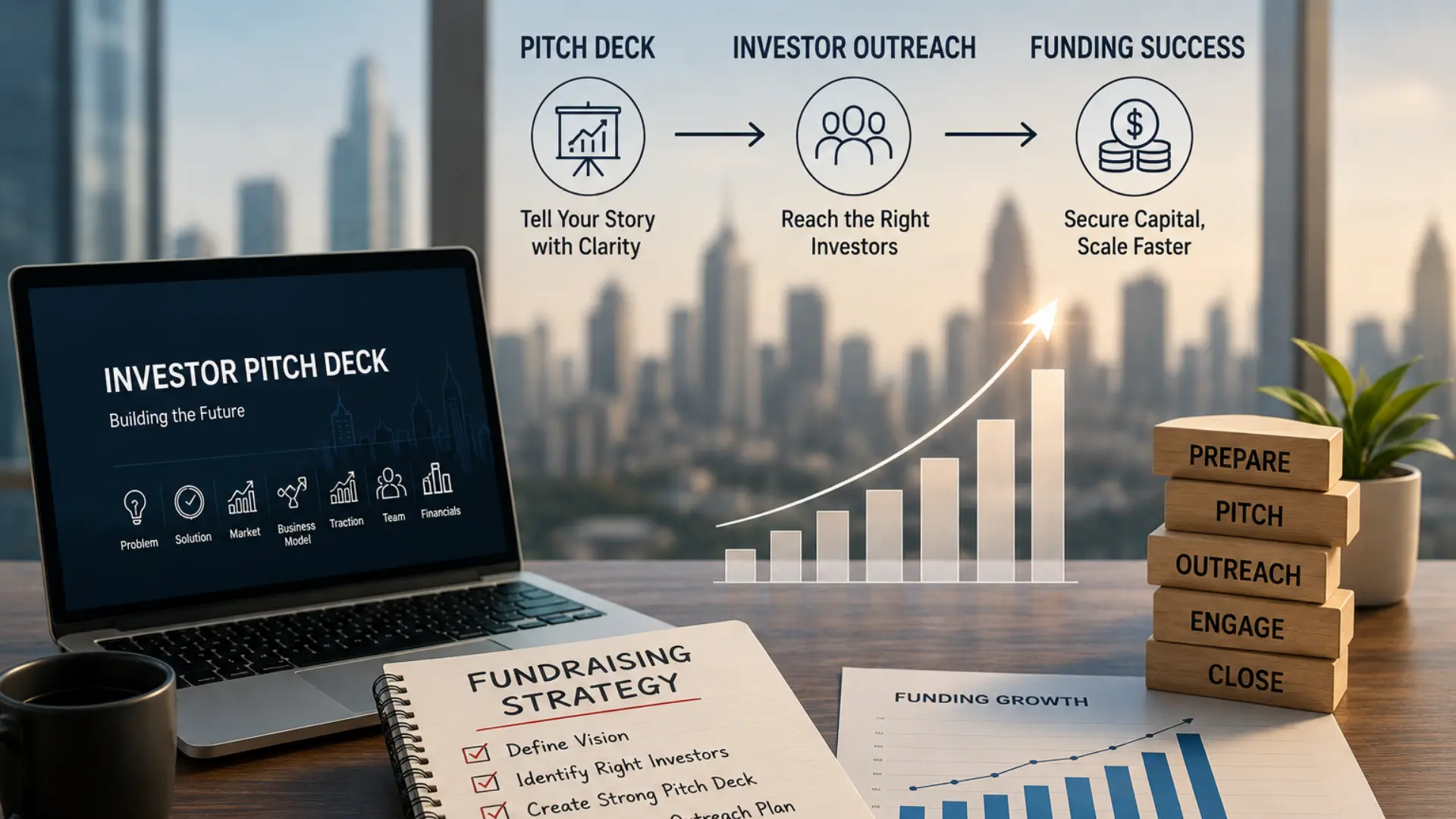
Raising capital is one of the most critical milestones in a startup’s growth journey. However, many founders spend months approaching investors without receiving meaningful responses. The reason is simple—successful fundraising requires much more than a great idea. It demands a well-planned fundraising strategy India, a compelling pitch deck, and a structured investor outreach process.
In today’s competitive startup ecosystem, investors evaluate hundreds of opportunities every month. Startups that communicate clearly, demonstrate traction, and follow a strategic fundraising process are far more likely to secure investment.
This guide explains how founders can build a winning fundraising strategy India, create an effective pitch deck strategy India, and execute a successful investor outreach plan in 2026.
Why a Fundraising Strategy India Matters
Many startups begin fundraising without a clear roadmap. As a result, they approach the wrong investors, present weak pitches, and struggle to gain traction.
A structured fundraising strategy India helps startups:
- Identify the right investors
- Improve fundraising efficiency
- Increase investor confidence
- Create better financial narratives
- Shorten fundraising cycles
- Improve valuation discussions
The most successful startups treat fundraising like a sales process—with preparation, targeting, and consistent follow-up.
Understanding the Startup Funding Landscape in India
Before approaching investors, founders must understand the different funding options available.
Bootstrapping
Self-funding remains a common option for early-stage startups.
Benefits include:
- Full ownership control
- No investor pressure
- Flexible decision-making
Angel Investors
Angel investors provide early-stage capital and mentorship.
Ideal for:
- MVP-stage startups
- Early market validation
- Initial growth funding
Seed Funding
Seed investors support startups preparing for scale.
Funding is typically used for:
- Product development
- Team expansion
- Customer acquisition
Venture Capital
VC firms invest in startups with high-growth potential.
Investors evaluate:
- Scalability
- Market opportunity
- Revenue growth
- Competitive advantage
Understanding these funding stages is the first step in developing a strong fundraising strategy India.
Building a Winning Pitch Deck Strategy India
Your pitch deck is often the first impression investors have of your startup.
A strong pitch deck strategy India can significantly improve investor interest and meeting conversion rates.
Slide 1: Company Overview
Start with a concise introduction.
Include:
- Company name
- Vision statement
- Tagline
- Industry focus
Keep this slide simple and impactful.
Slide 2: Problem Statement
Clearly explain the market problem.
Investors want to understand:
- Why the problem exists
- Who faces the problem
- Why solving it matters
A strong problem statement creates urgency and relevance.
Slide 3: Your Solution
Show how your startup solves the problem.
Focus on:
- Product benefits
- Competitive advantages
- Innovation
Avoid overly technical explanations.
Slide 4: Market Opportunity
Investors want to know the size of the opportunity.
Include:
- TAM (Total Addressable Market)
- SAM (Serviceable Available Market)
- SOM (Serviceable Obtainable Market)
Market potential is a critical element of any pitch deck strategy India.
Slide 5: Business Model
Explain how your startup generates revenue.
Include:
- Pricing structure
- Revenue streams
- Customer acquisition strategy
A clear business model builds investor confidence.
Slide 6: Traction and Growth
Traction validates demand.
Examples include:
- Revenue growth
- Active users
- Customer acquisition
- Partnerships
- Retention metrics
Strong traction significantly improves fundraising outcomes.
Slide 7: Financial Projections
Investors expect realistic projections.
Include:
- Revenue forecasts
- Growth assumptions
- Funding utilization
- Profitability roadmap
Avoid unrealistic numbers.
Slide 8: Team
Investors often invest in founders as much as the idea.
Highlight:
- Founder expertise
- Industry experience
- Leadership capabilities
A strong team can overcome many business challenges.
Creating an Effective Investor Outreach Plan
Even the best pitch deck cannot generate results without a strong investor outreach plan.
Fundraising success depends on targeting the right investors and building relationships strategically.
Identify the Right Investors
Not every investor is suitable for your startup.
Research:
- Investment stage
- Industry focus
- Portfolio companies
- Investment size
A targeted investor outreach plan improves response rates significantly.
Build a Qualified Investor List
Create a database including:
- Investor name
- Firm
- Contact details
- Industry preferences
- Previous investments
Organization improves outreach efficiency.
Use Warm Introductions
Investors are more likely to respond through referrals.
Potential sources include:
- Existing investors
- Mentors
- Founders
- Advisors
- Startup communities
Warm introductions often outperform cold outreach.
Craft a Strong Outreach Message
Your first email should be concise and compelling.
Include:
- Brief company introduction
- Problem being solved
- Key traction metrics
- Funding requirement
- Request for a meeting
The objective is to secure interest—not explain everything.
Follow Up Professionally
Many investors require multiple touchpoints before responding.
Best practices:
- Follow up after 5–7 days
- Share meaningful updates
- Remain professional and concise
Persistence often leads to opportunities.
Common Fundraising Mistakes Startups Make
Many startups fail because of avoidable mistakes.
Poor Investor Targeting
Approaching investors outside your sector wastes valuable time.
Weak Storytelling
Investors remember stories more than data alone.
Unrealistic Valuations
Overvaluing the business creates unnecessary friction.
Lack of Preparation
Founders must anticipate investor questions.
No Follow-Up Process
Consistent communication is essential.
Avoiding these mistakes strengthens your fundraising strategy India.
What Investors Look for in Startups
Investors evaluate several key factors before making decisions.
Market Opportunity
Can the business become large and scalable?
Founder Capability
Can the team execute successfully?
Product-Market Fit
Is there proven demand?
Traction
Are customers actively using the solution?
Financial Potential
Can the company generate attractive returns?
Understanding these priorities improves both your pitch deck strategy India and investor conversations.
Fundraising Trends in India for 2026
The fundraising environment continues to evolve rapidly.
AI and SaaS Startups
Investors remain highly interested in technology-driven businesses.
ESG-Focused Investments
Sustainability and impact-driven startups are attracting increased capital.
Profitability Over Hypergrowth
Investors now prioritize sustainable business models.
Tier-2 and Tier-3 Startup Growth
Regional startup ecosystems are receiving greater investor attention.
These trends should be considered when building a modern fundraising strategy India.
Why Professional Fundraising Support Can Help
Many startups work with investor relations and fundraising consultants to improve outcomes.
Professional support includes:
- Pitch deck development
- Financial storytelling
- Investor outreach
- Fundraising strategy planning
- Investor communication
- Due diligence preparation
Expert guidance can significantly improve fundraising efficiency and investor engagement.
Conclusion
A successful fundraising strategy India requires more than approaching investors with a good idea. Founders must build a compelling narrative, create a professional pitch deck, and execute a targeted investor outreach plan.
By developing a strong pitch deck strategy India, identifying the right investors, demonstrating traction, and maintaining consistent communication, startups can dramatically improve their chances of raising capital successfully.
In an increasingly competitive startup ecosystem, preparation, positioning, and persistence remain the keys to fundraising success.
Frequently Asked Questions
What is a fundraising strategy India?
A fundraising strategy is a structured plan that helps startups identify investors, prepare fundraising materials, and secure capital effectively.
What should a startup pitch deck include?
A pitch deck should include the problem, solution, market opportunity, business model, traction, financial projections, and team information.
Why is an investor outreach plan important?
A structured investor outreach plan helps startups target the right investors, improve response rates, and manage fundraising efficiently.
How long does fundraising usually take?
Fundraising timelines vary but typically range from 3 to 9 months depending on startup stage, market conditions, and investor interest.